


Published Apr 1, 2025
Obtaining legal representation is crucial for noncitizens when facing immigration adjudication, especially
in situations of asylum and removal. Legal advocates across the United States have provided legal services
to millions of noncitizens over the decades. However, numerous barriers prevent certain individuals from
accessing legal services, one of them being language. As an example, individuals who primarily speak
Mandarin or Punjabi have been represented in more than 75 percent of cases brought before Immigration
Court since 1998. Individuals speaking Portuguese and Spanish have been represented in less than 40
percent of cases over the same time period.
This report analyzes the pattern between language proficiency as reported on court forms and access to
legal representation. It is based on case-by-case court records obtained from public records requests to
the Executive Office for Immigration Review (EOIR) made by the Transactional Records Access Clearinghouse
(TRAC). This report makes no causal claims—whether language proficiency leads to higher or lower
representation—but it does note patterns in representation that are not nationality-based, but linguistic.
Previous work on this topic by TRAC include a 2021 report finding that individuals with proficiency in
certain languages
fared worse than others in asylum proceedings. Another report documented the
language diversity
of migrants with pending cases under the so-called Migrant Protection Protocols. Interested readers can
explore these numbers further using the
Outcomes of Immigration Court Proceedings
tool on tracreports.org.
Language and Representation in Immigration Court
Properly conveying one’s story through language may be important in many legal contexts but is especially
crucial in immigration cases. Personal testimony is often pivotal in immigration decisions, especially in
situations involving a claim of asylum. Immigration adjudication in the United States is conducted in the
English language. Over the years, EOIR has created standards and guidelines for language access, including
interpretation services. However, many court watchers and legal advocates have observed that the byzantine
nature of immigration law continues to present particular disadvantages to individuals who speak languages
other than English. While the Court is required to provide interpreters for individuals, the court is not
required to provide an immigrant with legal counsel. Individuals who receive legal counsel are much more
likely to win relief from deportation.
Table 1 and Figure 1 together show changes in representation among the ten most frequently spoken
languages by noncitizens appearing in Immigration Court so far in fiscal year 2025, ordered by how often
individuals with each spoken language proficiency are represented in Court. Since the beginning of FY
2025, noncitizens have received legal counsel in about 38 percent of all immigration cases overall. Among
languages with at least 1,000 completed cases since the beginning of the fiscal year, Punjabi-speakers are
the most often represented in Immigration Court cases at 84 percent. Mandarin speakers have the
second-highest rate of receiving counsel, with representation in about 75 percent of cases.
Spanish-speakers have been represented in only 34 percent of cases so far this fiscal year while
Creole-speakers are the least-often able to access legal counsel, receiving representation in only 21
percent of cases.

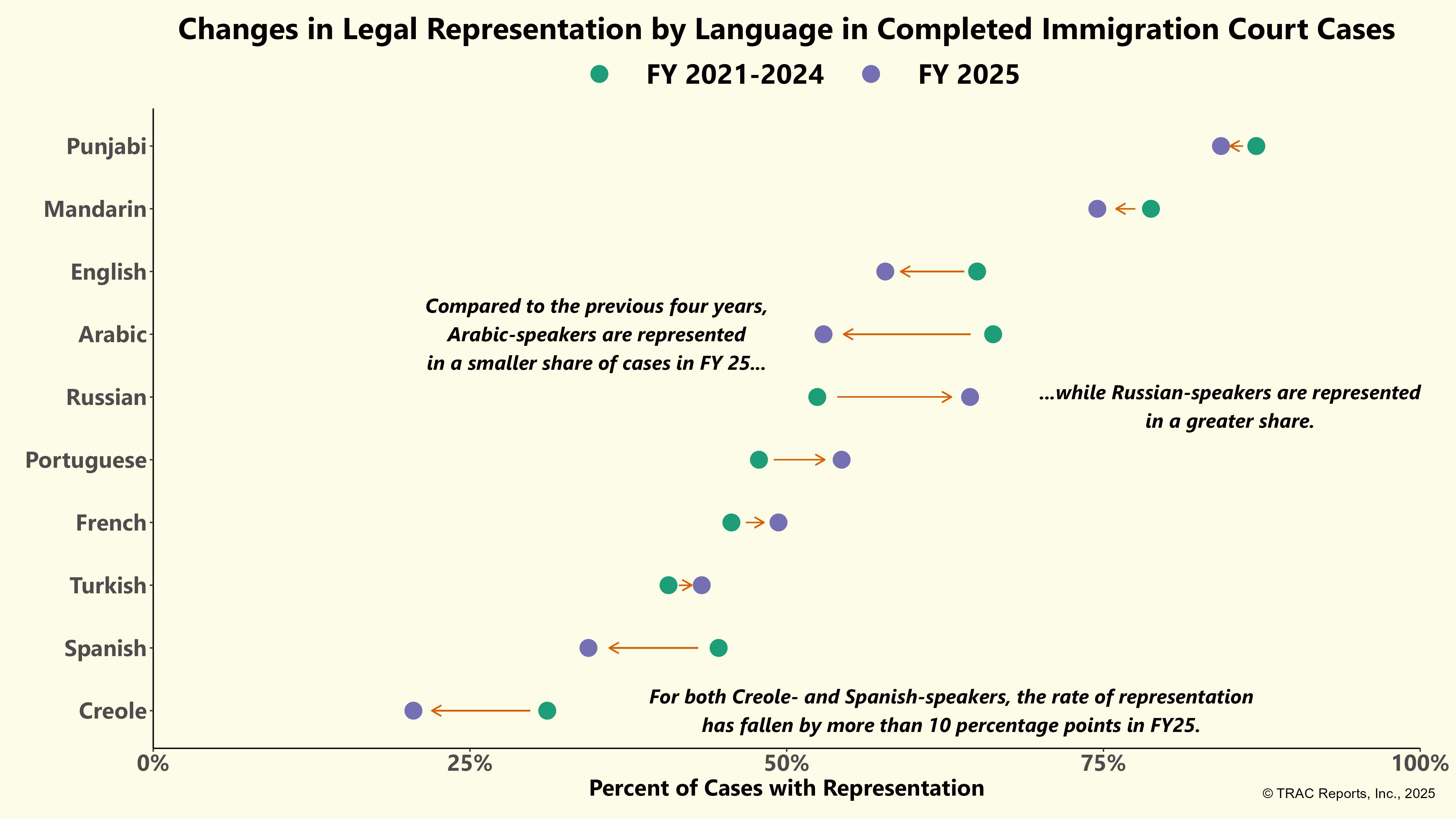
Figure 1. Changes in Legal Representation by Language in Completed Immigration Court Cases
Table 1. Representation and Completed Cases Over Time for the Top 10 Spoken Languages in Immigration
Court in FY 2025
| FY 2025* | FY 2021 – FY 2024 | FY 1998 – Present | ||||
|---|---|---|---|---|---|---|
| Language | All Completed Cases | Percent Represented | All Completed Cases | Percent Represented | All Completed Cases | Percent Represented |
| Punjabi | 3,015 | 84% | 19,756 | 87% | 60,535 | 77% |
| Mandarin | 3,630 | 75% | 28,511 | 79% | 157,065 | 78% |
| Russian | 3,603 | 64% | 30,034 | 52% | 74,465 | 63% |
| Other Languages | 17,290 | 63% | 114,650 | 66% | 440,550 | 65% |
| English | 10,524 | 58% | 94,932 | 65% | 817,674 | 55% |
| Portuguese | 9,791 | 54% | 62,200 | 48% | 146,143 | 38% |
| Arabic | 2,374 | 53% | 10,509 | 66% | 49,936 | 68% |
| French | 1,313 | 49% | 8,077 | 46% | 33,961 | 62% |
| Turkish | 1,864 | 43% | 11,101 | 41% | 16,758 | 46% |
| All | 374,507 | 38% | 2,175,201 | 48% | 7,597,892 | 43% |
| Spanish | 308,401 | 34% | 1,723,839 | 45% | 5,509,187 | 37% |
| Creole | 11,009 | 21% | 61,047 | 31% | 154,264 | 47% |
* as of the end of February 2025.
FY 2025 has seen a drop in representation in Immigration Court generally, but speakers of some languages,
including Russian, Portuguese, French, and Turkish, have experienced higher rates of representation in the
last five months than in the previous four years. In contrast, when comparing the previous four fiscal
years (FY2021-FY2024) to the last five months, representation for Arabic-, Creole-, and Spanish-speaking
noncitizens have dropped off by ten percentage points or more.
Noncitizens whose first language is not as commonly spoken face greater barriers to representation.
Finding quality interpreters can be more difficult, which can make providing legal counsel more
challenging. For example, out of the nearly 350,000 completed cases in the first five months of FY 2025,
court records indicate that 531 people spoke Kekchi, a language common to Maya indigenous communities
based out of southern Mexico, Guatemala, and Belize.
A total of 209, or 39 percent, of noncitizens speaking Kekchi were represented in court.
Outcomes of Representation and Language Access Going Forward
To reiterate, there are many factors that influence the outcomes of immigration cases. Clearly outcomes
cannot be solely attributed to language barriers, even if linguistic differences may influence negative
outcomes for some noncitizens. Certain patterns do emerge from a brief analysis. Table 2 shows the
languages included in Table 1, with the percentage of cases in which an Immigration Judge issued a removal
order and the proportion who were represented.
Including all languages, about 83 percent of removal orders in FY 2025 are issued to noncitizens who do
not have legal counsel. For speakers of Creole, the number of cases in which a noncitizen who has no
representation receives a removal order is very high (93%). Spanish-speakers have received over 80 percent
of all removal orders in FY 2025 and are unrepresented in more than 85 percent of cases that result in
removal.
Table 2. Removal Orders and Representation for the Top 10 Spoken Languages in Immigration Court in FY
2025*
| Language | Removal Orders | Represented (%) | Not Represented (%) |
|---|---|---|---|
| All | 157,577 | 27,502 (17.5) | 130,075 (82.5) |
| Spanish | 137,667 | 19,929 (14.5) | 117,738 (85.5) |
| Other Languages | 6,721 | 2,856 (42.5) | 3,865 (47.5) |
| English | 3,580 | 1,086 (30.3) | 2,494 (69.7) |
| Portuguese | 3,143 | 1,260 (40.1) | 1,883 (59.9) |
| Creole | 1,420 | 97 (6.8) | 1,323 (93.2) |
| Russian | 1,211 | 543 (44.8) | 668 (55.2) |
| Mandarin | 1,124 | 635 (56.5) | 489 (43.5) |
| Turkish | 964 | 272 (28.2) | 692 (71.8) |
| Arabic | 687 | 218 (31.7) | 469 (68.3) |
| Punjabi | 613 | 500 (81.6) | 113 (18.4) |
| French | 447 | 106 (23.7) | 341 (76.3) |
* as of the end of February 2025.
On March 1, 2025, President Donald Trump signed an
executive order
entitled “Designating English as an Official Language of The United States.” Questions of
constitutionality aside, it’s still to be determined how this action will be implemented across agencies,
including at EOIR. Language access remains an integral part of full participation in legal proceedings and
will continue to require attention from court officials, legal advocates, and civil society stakeholders
who have an interest in ensuring due process in Immigration Court.
Footnotes
Kekchi can be spelled Q’eqchi’, K’ekchi’ or Kekchí. It is important to note here that the
transliteration of some languages—especially indigenous languages—into English can result in multiple
ways to spell the name of a language. Each distinct spelling may carry political, cultural, or social
significance. TRAC uses the language names as recorded in the Immigration Court’s files.
analysis.
trac.syr.edu to tracreports.org. For more information, contact
info@tracreports.org.
link